Ferlins are ancient membrane proteins with a unique architecture, and play central roles in crucial processes that involve Ca 2+ -dependent vesicle fusion. Despite their links to multiple human diseases and numerous functional studies, a mechanistic understanding of how these multi-C 2 domain-containing proteins interact with lipid membranes to promote membrane remodelling and fusion is currently lacking. Here we obtain near-complete cryo-electron microscopy structures of human myoferlin and dysferlin in their Ca 2+ - and lipid-bound states. We show that ferlins adopt compact, ring-like tertiary structures upon membrane binding. The top arch of the ferlin ring, composed of the C 2 C-C 2 D region, is rigid and e... More
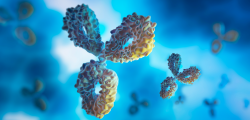
Ferlins are ancient membrane proteins with a unique architecture, and play central roles in crucial processes that involve Ca 2+ -dependent vesicle fusion. Despite their links to multiple human diseases and numerous functional studies, a mechanistic understanding of how these multi-C 2 domain-containing proteins interact with lipid membranes to promote membrane remodelling and fusion is currently lacking. Here we obtain near-complete cryo-electron microscopy structures of human myoferlin and dysferlin in their Ca 2+ - and lipid-bound states. We show that ferlins adopt compact, ring-like tertiary structures upon membrane binding. The top arch of the ferlin ring, composed of the C 2 C-C 2 D region, is rigid and exhibits only little variability across the observed functional states. In contrast, the N-terminal C 2 B and the C-terminal C 2 F-C 2 G domains cycle between alternative conformations and, in response to Ca 2+ , close the ferlin ring, promoting tight interaction with the target membrane. Probing key domain interfaces validates the observed architecture, and informs a model of how ferlins engage lipid bilayers in a Ca 2+ -dependent manner. This work reveals the general principles of human ferlin structures and provides a framework for future analyses of ferlin-dependent cellular functions and disease mechanisms.SynopsisMulti-C 2 domain-containing ferlin proteins have key roles in membrane repair and vesicle trafficking, as well as links to various diseases, but the details of how they engage lipid bilayers are unknown. This study captures multiple cryo-EM snapshots of myoferlin and dysferlin, providing novel insights into the structural basis of ferlin function.Ferlins are more dynamic in their lipid-free state, whereas they adopt a compact, ring-like structure upon membrane binding. Myoferlin establishes a composite lipid membrane interface involving multiple C 2 domains (s.c. C 2 B, C 2 C, C 2 F-C 2 G) and an accessory motif (s.c. inner DysF). Ferlins undergo large-scale conformational rearrangements to facilitate tight vesicle docking and remodelling of the target membrane.Cryo-EM structures of myoferlin and dysferlin reveal how ferlins interact with lipid bilayers.