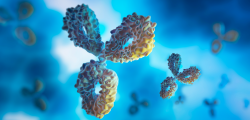
Rabbit monoclonal antibodies (RabMAbs) can recognize diverse epitopes, including those poorly immunogenic in mice and humans. However, there have been only a few reports on RabMAb humanization, an important antibody engineering step usually done before clinical applications are investigated. To pursue a general method for humanization of RabMAbs, we analyzed the complex structures of 5 RabMAbs with their antigens currently available in the Protein Data Bank, and identified antigen-contacting residues on the rabbit Fv within the 6 Angstrom distance to its antigen. We also analyzed the supporting residues for antigen-contacting residues on the same heavy or light chain. We identified "HV4" and "LV4" in ... More
Rabbit monoclonal antibodies (RabMAbs) can recognize diverse epitopes, including those poorly immunogenic in mice and humans. However, there have been only a few reports on RabMAb humanization, an important antibody engineering step usually done before clinical applications are investigated. To pursue a general method for humanization of RabMAbs, we analyzed the complex structures of 5 RabMAbs with their antigens currently available in the Protein Data Bank, and identified antigen-contacting residues on the rabbit Fv within the 6 Angstrom distance to its antigen. We also analyzed the supporting residues for antigen-contacting residues on the same heavy or light chain. We identified "HV4" and "LV4" in rabbit Fvs, non-complementarity-determining region (CDR) loops that are structurally close to the antigen and located in framework 3 of the heavy chain and light chain, respectively. Based on our structural and sequence analysis, we designed a humanization strategy by grafting the combined Kabat/IMGT/Paratome CDRs, which cover most antigen-contacting residues, into a human germline framework sequence. Using this strategy, we humanized 4 RabMAbs that recognize poorly immunogenic epitopes in the cancer target mesothelin. Three of the 4 humanized rabbit Fvs have similar or improved functional binding affinity for mesothelin-expressing cells. Interestingly, 4 immunotoxins composed of the humanized scFvs fused to a clinically used fragment of Pseudomonas exotoxin (PE38) showed stronger cytotoxicity against tumor cells than the immunotoxins derived from their original rabbit scFvs. Our data suggest that grafting the combined Kabat/IMGT/Paratome CDRs to a stable human germline framework can be a general approach to humanize RabMAbs.